
Roman Begins a New Era of Astronomy

Completed on budget and nine months ahead of schedule, NASA’s newest flagship space telescope is now heading toward L2—carrying more than 1.3 million names and the promise of a wider, faster view of our universe.

If you got your Roman boarding pass, congrats: you are also on your way to L2 to help change astronomy as we know it.
The woman whose vision made this possible
Before NASA had Hubble, Webb, or Roman, it needed a space astronomy program. Nancy Grace Roman helped build one.
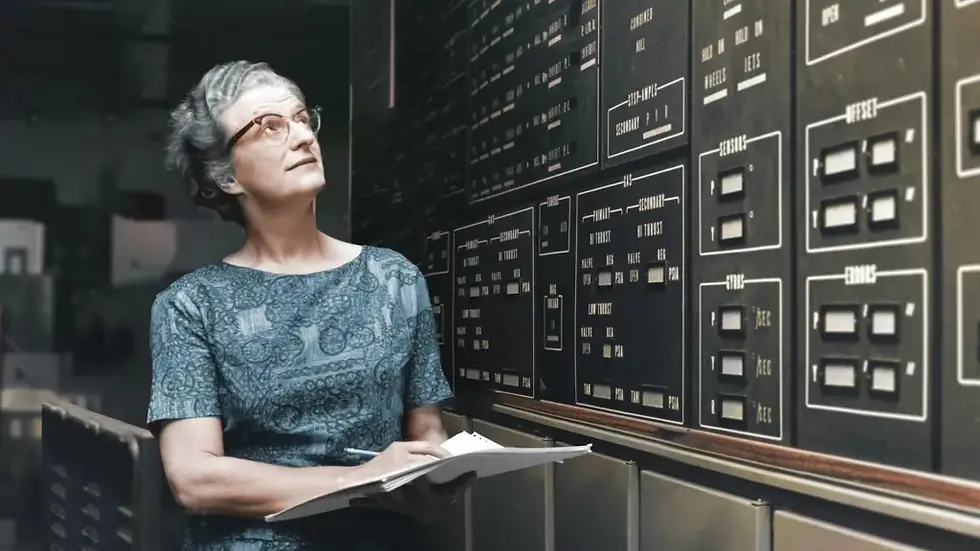
Roman joined NASA in 1959, only months after the agency was created. She became NASA’s first chief of astronomy, building support for telescopes that could observe the universe from above Earth’s atmosphere. She was the FIRST woman to hold an executive role in NASA. At a time when women were routinely discouraged from careers in astronomy, she was helping define what space-based astronomy could become.
Her influence is inseparable from the Hubble Space Telescope. Roman spent years developing scientific and political support for a large space telescope and helped secure congressional approval for the project, earning her the nickname “Mother of Hubble.” But her legacy reaches beyond one observatory: she helped lay the foundation for NASA’s Great Observatories program and for generations of missions that transformed our view of the cosmos.

That is why this telescope bears her name. It is not simply honoring an astronomer from NASA’s past. It is carrying her vision forward: ambitious space science, data made accessible to the public, with the power to reshape how humanity understands its place in the universe.
And there is something especially poetic about Roman now working alongside Hubble, the telescope she helped make possible.
The universe is getting the ultimate wide-angle photoshoot
Roman’s superpower is scale.
Its primary instrument, the Wide Field Instrument, is a 300-megapixel infrared camera designed to capture images with sharpness comparable to Hubble while seeing at least 100 times more sky in a single view.
Think of Roman, Hubble, and Webb as the ultimate cosmic camera bag. Roman is the wide-angle scout, surveying enormous stretches of sky to find rare galaxies, exploding stars, growing black holes, and distant worlds. Hubble and Webb can then zoom in for detailed close-up observations. Together, they can show us a universe none of them could reveal alone.
During its five-year primary science mission, Roman is expected to image more than 50 times as much sky as Hubble covered in its first 30 years. It can conduct some surveys up to 1,000 times faster than Hubble!
Roman will map billions of galaxies, watch stars brighten and change, search for planets throughout the Milky Way, and measure the large-scale structure of the universe with extraordinary precision.

It was designed to pursue questions that still sound almost like science fiction:
What is dark energy, the mysterious effect accelerating the expansion of the universe?
How is dark matter, the invisible framework helping shape galaxies?
How common are planetary systems like our own?
What worlds, objects, and phenomena are waiting in the data that scientists have not yet thought to search for?
Roman may uncover questions we do not yet know to ask. The kind of discoveries that do more than add a page to a science book...they rewrite the chapter.
“Excitement, powered by dark energy”

The day before launch, Her Cosmic Orbit attended NASA’s prelaunch news conference. Florida weather had put the odds of launch at 50-50, but the room was still full of anticipation. (Don't tell us the odds)
When Nicky Fox, associate administrator for NASA’s Science Mission Directorate, was asked how she was feeling, she delivered the ✨VIBE✨ of the day in four perfect words: “Excitement, powered by dark energy.”
And because groundbreaking science and personal style can absolutely share the same room, we need to pause for the details. Fox arrived with Roman and space-themed jewelry, nails to match. You know we love nail art at Her Cosmic Orbit, and this cosmic manicure deserves its close-up. Can we get some commotion for the nails!! 💅🏻

A perfect launch. No, actually it was PERFECT.

At exactly 7:26 a.m. EDT on August 30, 2026, a SpaceX Falcon Heavy lifted off from Launch Complex 39A at NASA’s Kennedy Space Center with Roman tucked inside its payload fairing.
The launch was perfect. No, actually perfect.

Roman separated as planned, established communications, and began deploying the systems it would need for its journey. Its solar arrays, sunshield, and communications dish all deployed in the first hours after liftoff. The Falcon Heavy’s two side boosters returned to Earth and landed, giving us both the spectacle and the landing photos to prove it. According to Rosie, who witnessed her first HEAVY launch, "The sonic boom was BOOMIN'"

The flawless flight capped an already remarkable development story. Despite a global pandemic and the complexity of building a flagship observatory, Roman was completed on budget and nine months ahead of schedule. After more than two decades of concepts, engineering, testing, advocacy, and teamwork, the observatory left Earth precisely when it was supposed to.
This is where the fun begins
As of today, Roman is now in a roughly three-month commissioning period as it travels toward the second Sun-Earth Lagrange point, or L2. This region, also used by the James Webb Space Telescope, will give Roman a stable thermal environment and a broad, unobstructed view of the sky while requiring relatively little fuel to maintain its orbit.
During commissioning, teams are deploying components, activating systems, cooling and testing the instruments, aligning the telescope, and calibrating everything for science. Roman is expected to enter its orbit around L2 in early December.
Roman’s 300-megapixel Wide Field Instrument has been activated, its 18 infrared detectors are operating, and its systems are working as expected. It has even collected its first photons of starlight in an intentionally out-of-focus engineering image that teams will use to align and sharpen the telescope. The Coronagraph Instrument has also completed its first checkout, with teams confirming communication and control across its major components.

NASA expects to release Roman’s first science images by early 2027. Until then, this stage of the mission is careful, methodical work: focus, calibration, testing, and verification before the science surveys begin.
A telescope for everyone
Roman is revolutionary not only because of what it will see, but because of who will be able to participate.
Its processed data will be made public without an exclusive access period. A researcher at a major university, a scientist in a country without its own space telescope, or a student discovering astronomy in a small community will be able to work from the same enormous archive of observations. Roman is expected to produce about 1.4 terabytes of data per day, so researchers will be able to access and analyze that information through cloud-based tools rather than needing a room full of their own computers.
That openness echoes Nancy Grace Roman’s belief that space observatories should serve the broader scientific community. Her legacy is not only the hardware in the sky. It is the doors that hardware can open here on Earth.
Follow Roman’s journey
Meet the people behind the mission
The telescope may be traveling a million miles from Earth, but Roman’s story is deeply human. Watch our interviews with the leaders helping guide the mission:
Dalia Kirschbaum, acting director of the Sciences and Exploration Directorate at NASA’s Goddard Space Flight Center — WATCH HERE
Lucas Paganini, Roman Space Telescope program executive at NASA Headquarters — WATCH HERE
Buy The Merch
Check out our shop for your Her Cosmic Orbit exclusive Roman Telescope merch!


Comments